Français










How to choose a floating pool bean bag
A floating pool bean bag comes down to three criteria: the cover fabric, which decides drying time and colour retention; the size, one seat or two; and the quality of the filling, which determines whether the seat stays comfortable season after season. This guide covers each of them, then compares the four Jumbo Bag floating models — including the cases where one of them is the wrong choice.
- What is a floating pool bean bag?
- How does a bean bag float without sinking?
- Floating bean bag, inflatable lilo or standard outdoor bean bag
- The deciding factor: mesh cover or solution-dyed canvas
- Which size should you choose?
- The four Jumbo Bag floating models compared
- Care: chlorine, salt, washing, drying
- Longevity: flattening, replacement covers, refills
- Safety: what a floating bean bag is not
- Frequently asked questions
What is a floating pool bean bag?
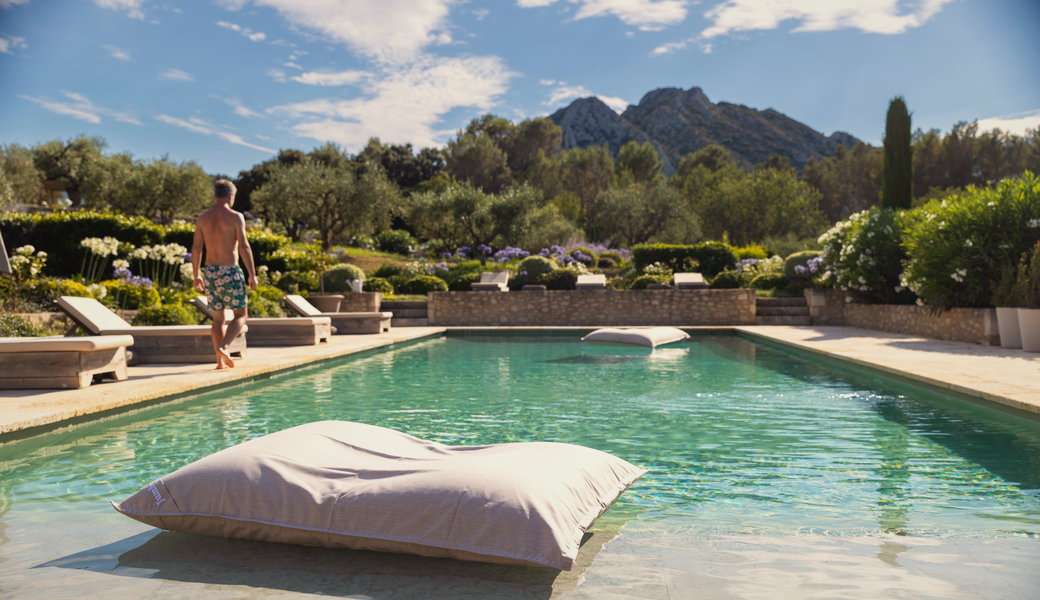
A floating pool bean bag is a padded seat designed to stay on the surface of the water. It is used in the pool, as a relaxation raft, and out of the water, as a large outdoor bean bag. Its buoyancy comes from its filling rather than an air chamber: there is nothing to inflate and nothing that can puncture.
That double life is what sets it apart from other pool accessories. An inflatable lilo is only useful in the water and gets stored deflated; a floating bean bag moves from terrace to pool with no transition, and occupies the poolside the rest of the time. So it is worth choosing as outdoor furniture as much as a water toy.
How does a bean bag float without sinking?
Two elements work together. The filling, made of virgin polystyrene beads, is lighter than water and provides the buoyancy. The cover has to be permeable: it lets water through instead of holding it in. The bean bag therefore does not soak up water, and stays on the surface even under load.
This is the point buyers often discover too late: a standard outdoor bean bag is water-repellent, meaning it is built to shed rain. Put it in a pool and it slowly fills, gets heavy and loses its shape. A pool bean bag does the opposite — its cover is deliberately open so that water drains away.
Two techniques achieve that permeability: honeycomb fabric, known as mesh, whose weave lets water through; and acrylic canvas backed with a PVC grid, where drainage happens through the lining. Choosing between the two is the real question, and it is covered below.
Floating bean bag, inflatable lilo or standard outdoor bean bag
An inflatable lilo is light and cheap, but it deflates, tips at the slightest movement and is vulnerable to punctures. A floating bean bag costs more upfront, never deflates, gives genuine back support and is usable out of the water too. For occasional use, an inflatable will do; for a pool used all summer, the bean bag lasts longer.
As for the standard outdoor bean bag — the one on the terrace — it is not made for immersion. Its water-repellent cover holds water in, its filling is not sized for buoyancy, and one summer in the pool is enough to distort it. This is not a question of price bracket: it is a different design.
What the market looks like. Floating pool bean bags range from around thirty euros for inflatable models to over 300 € for high-end branded bean bags. Within that range, what actually changes is the cover fabric and the origin of the filling beads — two things entry-level listings rarely mention.
The deciding factor: mesh cover or solution-dyed canvas
This choice shapes the entire range, and it is the one with the most impact in use. It affects neither comfort nor buoyancy — identical in both cases — but two very practical things: drying time and colour retention in the sun.
The mesh cover, in honeycomb polyester
Honeycomb fabric filters water efficiently and stays soft under the body. The downside: it is sponge-like. After a swim, both the fabric and the beads have to dry, which can take from one to several days depending on heat and wind. To speed things up, take the cover off and turn the inner cover over regularly.
Second point: polyester is surface-dyed. Prolonged exposure will eventually fade it, some colours faster than others. Fading affects neither buoyancy nor comfort — it is a cosmetic matter, not a technical one. There are two answers: bring the bean bag in when it is not in use, or replace the cover on its own.
Solution-dyed acrylic canvas
Solution-dyed means the pigment goes into the fibre while it is being made, rather than being applied to its surface: the colour is part of the yarn. It therefore does not wash out or wear off under exposure. That is what earns the Sunbrella® and Agora® canvases used by Jumbo Bag a 5-year guarantee against fading.
The other benefit is less well known and matters just as much day to day: acrylic does not soak up water the way sponge-like mesh does. The bean bag dries quickly and can be used on the ground shortly after swimming, without waiting for the filling to dry. On a pool used every day, that detail is what makes the difference.
How to decide. If the bean bag stays outdoors all season, or moves between swimming and ground use within the same day, solution-dyed canvas is the right call. If it comes out occasionally and is stored under cover between uses, a mesh cover does the job perfectly well for less.
Which size should you choose?
Size is chosen on available surface, not on load. Since buoyancy comes from polystyrene beads rather than an air chamber, the limit is room on the bean bag, not buoyancy: a two-seater takes two adults because there is space for two, not because a third would sink it.
- One-seater (around 130 × 80 cm) — the easiest to carry out, bring in and store off season. Suited to small poolsides and balconies.
- Mid-size (150 × 115 cm) — easier to handle in the water than a two-seater; this is the format designed for children.
- Two-seater (130 × 170 cm) — lets you stretch out fully on the water and doubles as a large outdoor bean bag the rest of the time.
A useful rule of thumb: the greater the filling volume, the more enveloping the seat and the more comfortable the buoyancy. But a large model full of water is also heavier to handle and slower to dry — which is why size should be considered alongside the fabric.
The four Jumbo Bag floating models compared
Jumbo Bag, a French brand designed in Toulouse, offers four floating models. They all share the same filling — 100 % virgin polystyrene beads — and the same permeable-cover principle. What separates them: size and fabric.
| Model | Size | Cover | Drying | Colour retention | Rule it out if… |
|---|---|---|---|---|---|
| Jumbo Swimming | 130 × 170 cm — 380 L two seats |
Honeycomb polyester (mesh) | 1 to several days | Fades over time under prolonged exposure | The bean bag stays outdoors permanently, or you want to use it on the ground the same day |
| Jumbo UV Swimming | 130 × 170 cm — 380 L two seats |
Sunbrella® solution-dyed acrylic canvas + PVC grid Oeko-Tex Standard 100 |
Fast | 5-year guarantee against fading | Budget comes first and the bean bag is stored under cover between swims |
| Junior UV Swimming | 150 × 115 cm — 250 L | Agora® solution-dyed acrylic canvas + PVC grid Oeko-Tex Standard 100 |
Fast | 5-year guarantee against fading | You want to stretch out two at a time: the format is deliberately smaller |
| Mini Jumbo Swimming | 130 × 80 cm — 200 L one seat |
Honeycomb polyester (mesh) | 1 to several days | Fades over time under prolonged exposure | Two of you want to enjoy it at the same time |
How to read this table
The two mesh models — Jumbo Swimming and Mini Jumbo Swimming — are the rational choice for a pool used now and then, with storage under cover. They float exactly as well as the others; it is drying and colour retention that call for a little discipline.
The two solution-dyed canvas models — Jumbo UV Swimming and Junior UV Swimming — are built to stay outdoors and to be used back to back. The Junior is the children's format of the range; the Jumbo UV matches the two-seater format of the Jumbo Swimming exactly.
One special case worth knowing. The Jumbo Swimming and the Jumbo UV Swimming share the same format, 130 × 170 cm for 380 litres. The Jumbo UV Swimming Cover therefore fits onto the filling of a standard Jumbo Swimming: you can start with mesh and move to solution-dyed canvas later, without buying a whole new bean bag.
Care: chlorine, salt, washing, drying
Jumbo Bag fabrics are tested to withstand chlorine and salt: the bean bag can be used in a treated pool as well as in sea water. After swimming, rinsing with clean water is still recommended, to remove the residues that dull fabrics over time. It is the single most worthwhile step in the whole care routine.
Every cover in the range is fully removable and machine washable at 30 °C. The outer cover comes off the filling, goes through the machine, then goes back on. The inner cover is microfibre polyester.
Dry it before storing it
On acrylic canvas models, drying is fast and rarely an issue. On mesh models, allow one to several days: the fabric is sponge-like and the beads have to dry too. Taking the cover off and turning the inner cover over from time to time speeds this up considerably.
For winter storage, the rule fits in one sentence: store the bean bag dry and under cover, and make sure it is completely dry before putting it away, filling included. A bean bag stored while still damp is exposed to odours and marks. Bringing it in when it is not in use also extends the life of the colours.
Longevity: flattening, replacement covers, refills
How long a floating bean bag lasts comes down to bead quality. Jumbo Bag filling is made of virgin polystyrene beads expanded in two stages: they do not crush and spring back to their round shape, which keeps the comfort over time. That is what sets them apart from the recycled or ground beads used in entry-level products, which have no resilience.
Two parts make it possible to extend a bean bag rather than replace it:
- The cover on its own. Each model has its replacement cover — Jumbo Swimming Cover, Jumbo UV Swimming Cover, Junior UV Swimming Cover, Mini Jumbo Swimming Cover — which fits back onto the existing filling.
- The bead refill. A 380-litre refill is sold separately to top up a filling.
In other words, the cover is the wear part and the filling is the durable one. A bean bag whose colours have faded is not a bean bag at the end of its life: it is a bean bag that needs a cover.
Safety: what a floating bean bag is not
A floating bean bag is a leisure accessory, not a safety device and not a flotation aid. It is no substitute for armbands, a buoy, a life jacket, or active adult supervision.
That caveat applies doubly to children. The smaller format of the Junior UV Swimming makes it easier for them to handle, but changes nothing here: a child should never be left alone on or near a bean bag in the water. A bean bag can flip over, drift out of reach, or slide under a swimmer.
Two further habits, whatever the age: do not use a floating bean bag outside a supervised pool, and never use one as a support for learning to swim.
Frequently asked questions
Is a floating pool bean bag really unsinkable?
Yes, provided its cover lets water through instead of holding it in. A permeable cover combined with a filling of 100 % virgin polystyrene beads keeps the bean bag on the surface, even under load. Pool bean bags with a solid cover eventually fill up and sink.
How many people can a floating bean bag hold?
The limit is available space, not buoyancy. A 130 × 170 cm model comfortably seats two adults; a 130 × 80 cm format is sized for one person. Since flotation comes from the filling rather than an air chamber, there is nothing to deflate and no loss of buoyancy over time.
Does a floating bean bag withstand chlorine and salt?
Yes. Jumbo Bag fabrics are tested to withstand chlorine and salt, so the bean bag can be used in a treated pool as well as in sea water. After swimming, rinsing with clean water is still recommended, to remove the residues that dull fabrics over time.
How long does a floating bean bag take to dry?
It depends on the fabric. Solution-dyed canvas models dry very quickly in the sun and can be used on the ground shortly after swimming. Mesh-cover models hold more water: the fabric is sponge-like and the beads have to dry too, which can take from one to several days depending on heat and wind.
Does the fabric of a pool bean bag fade in the sun?
A surface-dyed polyester cover will eventually fade under prolonged exposure, some colours faster than others; fading affects neither buoyancy nor comfort. Solution-dyed canvas, where the pigment is built into the fibre, resists it: Sunbrella® and Agora® are guaranteed 5 years against fading.
Does the filling go flat over time?
It all comes down to bead quality. A filling of virgin polystyrene beads expanded in two stages does not crush and springs back to its round shape, which keeps the comfort over time. The recycled or ground beads used in entry-level products have no resilience.
Can the cover of a pool bean bag be washed?
Yes. Covers in the floating range are fully removable: the outer cover comes off the filling to be machine washed at 30 °C, then goes back on. The inner cover is microfibre polyester.
How should a pool bean bag be stored over winter?
Store it dry and under cover. Before storing, make sure it is completely dry, filling included: take the cover off and turn the inner cover over from time to time to finish drying. A bean bag stored while still damp is exposed to odours and marks.
What is the difference between a pool bean bag and a standard outdoor bean bag?
A standard outdoor bean bag is water-repellent: it withstands rain but is not designed to be submerged. A pool bean bag is designed to float over time — a permeable cover so water drains away, and a filling chosen for buoyancy. Using a standard outdoor bean bag in a pool soaks it and distorts its shape.
All four models in the range are gathered on the floating bean bags page, each with its dimensions, composition and care instructions in full.